Experts in organisational disengagement
When knowledge depends on people, so does your company
We turn the knowledge of your key people into an organisational asset. Before resignation, absence or retirement takes years of expertise, critical know-how and valuable relationships out of your business.
The hidden problem
The risk is not alwaysthe person who leaves.
Sometimes the risk comes from people who are still there, but have already disengaged. They do their job, yet no longer share what they know. Critical knowledge rarely disappears overnight; it gradually becomes inaccessible.
Business units with higher engagement achieve significantly lower profitability.
Sales teams achieve worse results when there is a low level of engagement.
Lower performance in both production metrics and performance evaluations.
Organizations with disengaged employees deliver a worse experience for their customers.
Errors are more frequent when engagement declines and good practices are not applied consistently.
Teams with lower engagement record significantly more absences, impacting business continuity.
Even in industries with low turnover, disengagement leads more people to leave the organization.
In industries where turnover is already high, disengagement further increases the loss of talent.
Disengaged employees are less likely to take part in initiatives that strengthen the organisation, such as communities of practice, improvement programs, affinity groups, or well-being activities.
Organizational disengagement doesn’t just affect people—it directly impacts business performance, safety, quality, and long-term sustainability
Organizational disengagement doesn’t just affect people—it directly impacts business performance, safety, quality, and long-term sustainability.
Business units with higher engagement achieve significantly lower profitability.
Sales teams achieve worse results when there is a low level of engagement.
Lower performance in both production metrics and performance evaluations.
Organizations with disengaged employees deliver a worse experience for their customers.
Errors are more frequent when engagement declines and good practices are not applied consistently.
Teams with lower engagement record significantly more absences, impacting business continuity.
Even in industries with low turnover, disengagement leads more people to leave the organization.
In industries where turnover is already high, disengagement further increases the loss of talent.
Disengaged employees are less likely to take part in initiatives that strengthen the organisation, such as communities of practice, improvement programs, affinity groups, or well-being activities.
When a person leaves, the organization loses far more than just another pair of hands
Processes, decisions, experience, judgement, and relationships. The impact isn’t always immediate. But when it becomes apparent, the consequences are significant.

Quiet quitting
They are still there, but they no longer share their knowledge.

Retirements and Resignations
Decades of experience lost if they were never capturedDecades of experience lost if they were never captured.

Invisible processes
Decisions and practices that exist only in the experience of a few people.
01 – ASSESSMENT
We discriminate what matters from what doesn’t
We identify the knowledge that truly keeps your business running, using objective and documented criteria. No assumptions.
02 — KNOWLEDGE STRUCTURING
We turn expertise into actionable documentation
Corporate wikis and knowledge maps capture the expertise of experienced professionals, making it accessible, reusable and transferable across the organisation.
03 — KNOWLEDGE PROTECTION
We reduce dependency on individuals
We redesign processes so that knowledge flows across the organisation instead of remaining with individuals.
04 — METHODOLOGY
Enterprise architecture, not just interviews
Structured and auditable processes. Every methodological decision is fully traceable. The results can be independently verified
01 – ASSESSMENT
We discriminate what matters from what doesn’t
We identify the knowledge that truly keeps your business running, using objective and documented criteria. No assumptions.
02 — KNOWLEDGE STRUCTURING
We turn expertise into actionable documentation
Corporate wikis and knowledge maps capture the expertise of experienced professionals, making it accessible, reusable and transferable across the organisation.
03 — KNOWLEDGE PROTECTION
We reduce dependency on individuals
We redesign processes so that knowledge flows across the organisation instead of remaining with individuals.
04 — METHODOLOGY
Enterprise architecture, not just interviews
Structured and auditable processes. Every methodological decision is fully traceable. The results can be independently verified.
The difference
Traditional Consulting
vs. the GEIST Method
Most knowledge management projects end when the consultant leaves. Ours don’t
Action
Assessment
Traceability
Results
Dependency
Knowledge Asset
Traditional Consulting
Open interviews, subjective judgement
Difficult to verify
Qualitative, difficult to measure
Dependent on the consultant
A report that no one uses
GEIST METHOD
Structured modelling with clearly defined procedures
Auditable at every step
Operational KPIs from the start
The system works without us
Knowledge embedded in the organisation
The difference
Traditional Consulting vs. the GEIST Method
Most knowledge management projects end when the consultant leaves. Ours don’t.
Action
Assessment
Traceability
Results
Dependency
Knowledge Asset
Traditional Consulting
Open interviews, subjective judgement
Difficult to verify
Qualitative, difficult to measure
Dependent on the consultant
A report that no one uses
GEIST METHOD
Structured modelling with clearly defined procedures
Auditable at every step
Operational KPIs from the start
The system works without us
Knowledge embedded in the organisation

Business carries on, even as people change
Continuity no longer depends on individuals. The organisation retains what it needs to continue operating as normal.

Experience doesn’t disappear
Every success and every mistake becomes a reusable asset, rather than disappearing along with the person who experienced them.

Your competitive advantage is no longer vulnerable
Competitive advantage shifts from being tied to specific individuals to becoming part of the organisation’s permanent capabilities.

Onboarding talent is easier
New recruits gain access from day one to the way of working and the context they need to add value.

The value endures, even when commitment wanes
The organisation continues to move forward even if some people become less involved, because what is essential is already part of its shared heritage.
Industry-proven
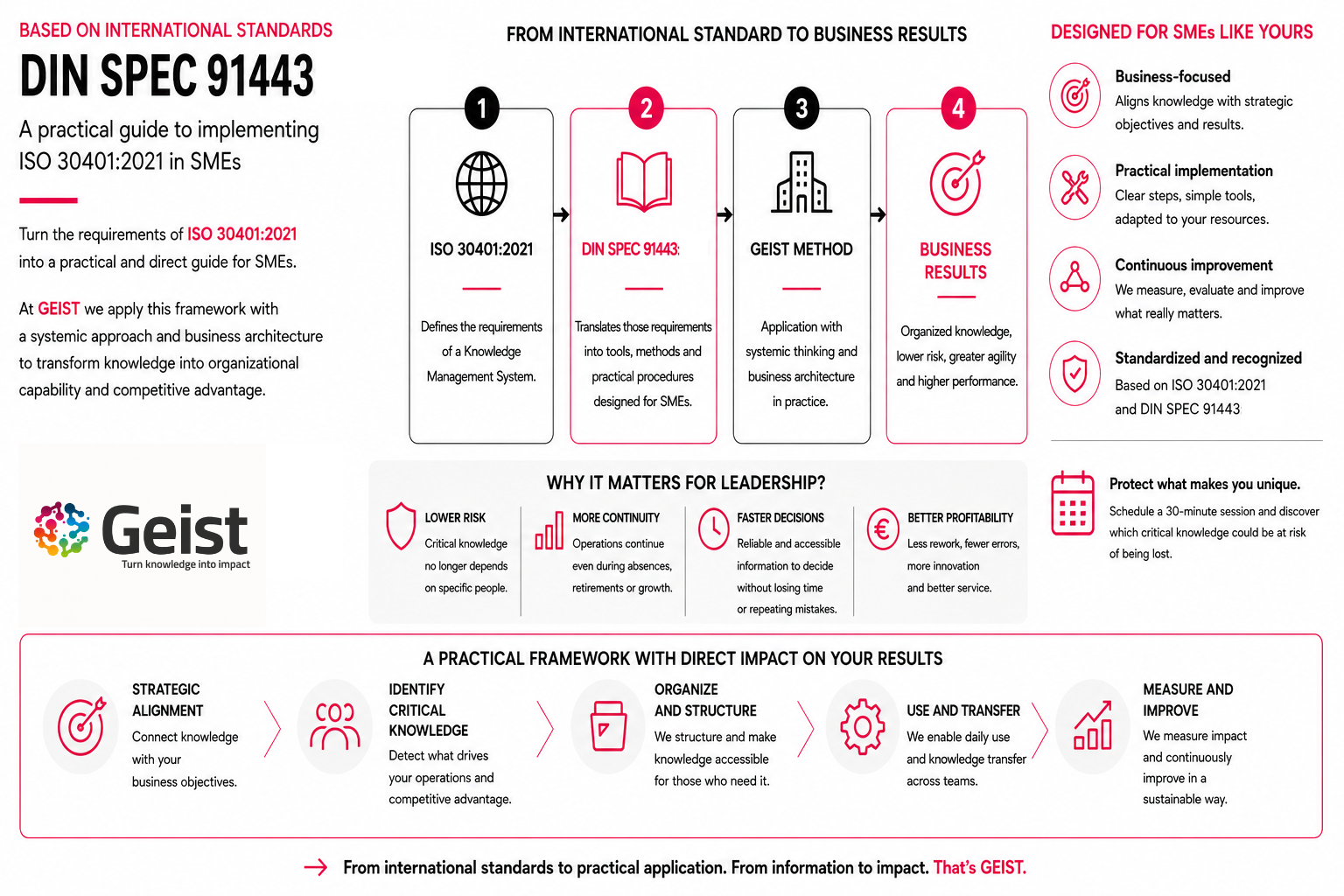
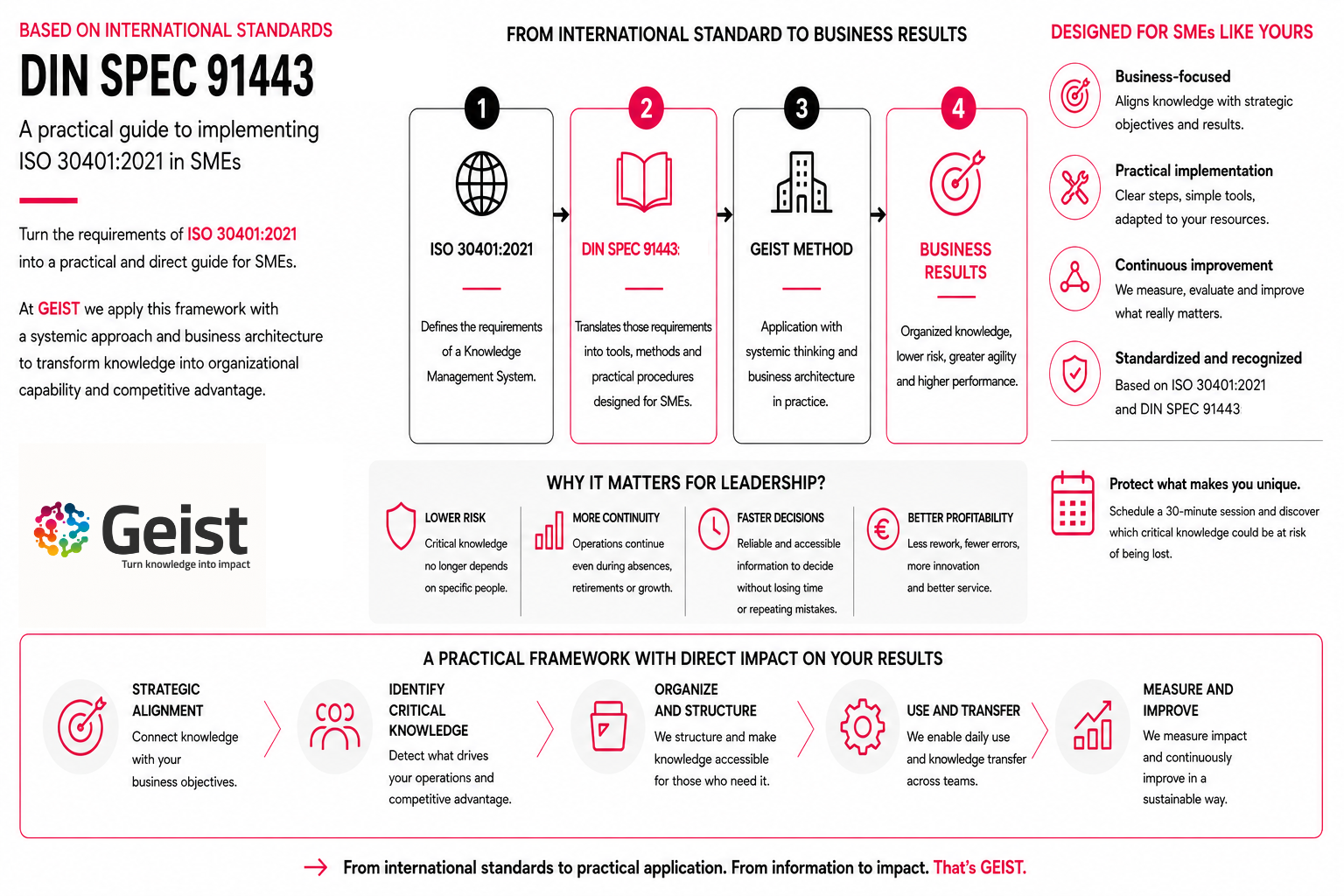
We work with the GEIST Method
This is not a theoretical framework. It is a methodology developed and proven in industrial environments, where mistakes have real consequences. An approach built on structure, method and traceability.

01.
AUTOMOTION

02.
AEROESPACE

03.
DEFENSE

04.
RAILWAY